When you own a commercial property in the heart of Saskatchewan, you aren't just managing a building; you are managing an environment. Whether you are operating a massive warehouse in Saskatoon, a retail hub in Prince Albert, or an industrial facility in North Battleford, your biggest adversary is the weather. With temperatures that swing from scorching prairie summers to the bone-chilling, -40°C depths of winter, your insulation choice isn’t just a construction detail: it’s a financial strategy.
Historically, fiberglass batt insulation was the default choice. It’s familiar, it’s cheap, and it’s everywhere. But as energy codes become more stringent and heating costs continue to climb, savvy property owners are looking for something better. Enter spray foam insulation, the technologically superior alternative that is revolutionizing how we protect our commercial investments.
If you’ve been weighing the initial savings of fiber batt against the high-performance promises of spray foam, you’ve come to the right place. Here is why the choice you make today will dictate your building's comfort, structural integrity, and profitability for the next 50 years.
The Traditional Contender: Understanding Fiber Batt
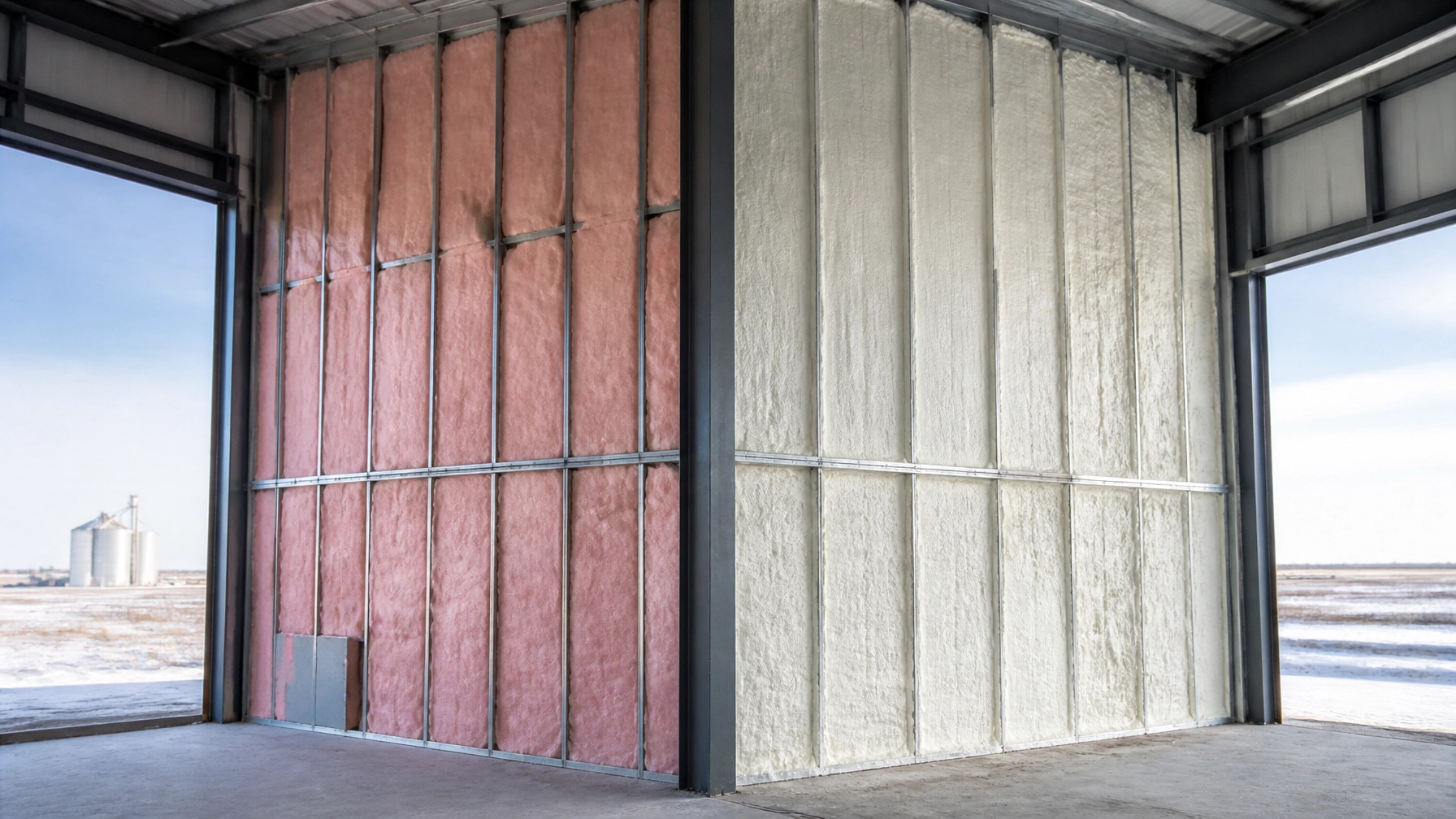
Fiberglass batt insulation is the "old guard." It consists of flexible blankets made from fine glass fibers. You’ve seen it a thousand times: those pink or yellow rolls tucked between wall studs.
Still not convinced it’s outdated? Consider how it works. Fiber batt relies on "dead air" trapped within the fibers to slow down heat transfer. In a perfect laboratory setting, it performs adequately. However, a commercial building in Melfort or Tisdale is not a laboratory. It’s a real-world environment subject to wind, moisture, and settling.
The Problem: Fiber batt is notoriously difficult to install perfectly. Even a tiny 1% gap in the insulation can lead to a 25% to 40% loss in effective R-value. In a large commercial space, those gaps are inevitable around electrical conduits, plumbing, and structural steel beams. Furthermore, fiber batt is not an air barrier. This means that while it might slow down heat moving through the material, it does absolutely nothing to stop the Saskatchewan wind from whistling through your wall assemblies.
The Modern Champion: Why We Love Spray Foam
At Spray-It, we cherish the opportunity to show our clients what modern technology can do for their bottom line. Spray foam: specifically closed-cell spray foam: is a spray-applied plastic that expands upon contact to fill every nook, cranny, and crevice.

When we apply spray foam in a facility in Humboldt, we aren’t just "stuffing" a wall; we are creating a seamless, airtight monolithic barrier. It doesn't just insulate; it seals.
1. Superior Energy Efficiency
In the extreme climate of Saskatchewan, energy efficiency isn't just a buzzword: it's survival. Closed-cell spray foam boasts an impressive R-value of approximately R-6 to R-7 per inch, nearly double that of traditional fiber batts (which hover around R-3.5).
Because spray foam acts as a total air barrier, it eliminates the drafts and convection loops that plague fiberglass-insulated buildings. Industry metrics show that commercial buildings switching to spray foam can reduce their energy consumption by up to 40%. Imagine what that does for your monthly overhead in the dead of January.
2. Structural Benefits You’ll Cherish
Here is a benefit most people don't expect: structural strength. Closed-cell spray foam is incredibly dense and has powerful adhesive qualities. When applied to the interior of a steel building or a wood-framed structure, it acts like glue, bonding the entire envelope together.
Studies have shown that spray foam can increase the racking strength of a wall by up to 200–300%. For a large-span commercial building in the windy prairies, this extra rigidity helps protect your investment against the elements and heavy wind loads.
3. Moisture and Condensation Control
Saskatchewan commercial buildings, especially those with metal siding or roofs, are prone to "sweating." When warm interior air hits a cold metal surface, condensation forms. This leads to rust, mold, and premature building failure.
Fiber batt is a disaster in these scenarios because it holds moisture like a sponge, losing its R-value and inviting rot. Spray foam solves this immediately. Because it is applied directly to the substrate and creates an airtight seal, moisture-laden air can never reach the cold surface. It acts as its own vapor retarder, keeping your building bone-dry and healthy.
The Real Cost: Upfront vs. Long-Term Value
We know what you’re thinking: "Spray foam costs more." You’re right: initially. The upfront cost of spray foam can be 3 to 4 times higher than fiber batt. However, viewing insulation as a one-time expense rather than a long-term investment is a mistake that costs Saskatchewan business owners thousands every year.
| Feature | Fiber Batt | Closed-Cell Spray Foam |
|---|---|---|
| Initial Cost | Low | Moderate/High |
| R-Value per Inch | ~3.5 | ~6.0 – 7.0 |
| Air Sealing | None (Requires extra layers) | Built-in Air Barrier |
| Moisture Resistance | Poor (Absorbs water) | Excellent (Waterproof) |
| Lifespan | 15-20 Years (Sags/Settles) | 50+ Years (Permanent) |
| Structural Impact | None | Adds Strength/Rigidity |
If you look at the Total Cost of Ownership, the math changes quickly. Between the energy savings, the lack of maintenance, the extended life of your HVAC systems (which don't have to work nearly as hard), and the increased property value, spray foam typically pays for itself in 3 to 5 years. After that, it’s pure profit staying in your pocket.

Why Experience Matters: The Spray-It Advantage
Applying spray foam in a commercial setting is a precision task. It requires the right chemicals, the right temperature, and: most importantly: the right expertise. At Spray-It, we have years of historical expertise serving the Saskatchewan business community.
We don't just "spray and go." We analyze your building's specific needs. Are you insulating a cold-storage facility in Prince Albert? A high-traffic retail space in Saskatoon? Or a massive steel shop in North Battleford? Each of these requires a tailored approach to ensure you get the maximum ROI.
We suggest spray foam because we’ve seen the alternative fail. We’ve seen the sagging batts, the frozen pipes, and the skyrocketing utility bills. Our mission is to provide you with a permanent solution that you can trust for the life of your building.
Choosing the Right Path for Your Project
If your primary goal is the absolute lowest possible construction bid and you aren't concerned with long-term operating costs, fiber batt might be your choice. But if you want a building that is tough, efficient, and comfortable, spray foam is the only technological choice that makes sense in the 21st century.
Still have questions about your specific project? We would love to chat! Whether you are in the planning stages of a new build or looking to retrofit an existing commercial space in Melfort, Tisdale, or Humboldt, our experts are here to help.
Check out our full range of commercial services and see how we’ve helped businesses across Saskatchewan achieve superior comfort and savings.

Conclusion: Invest in Excellence
Your building is the shell that protects your business, your employees, and your equipment. Why settle for a 1950s solution for a 2026 challenge? By choosing spray foam, you are choosing to lower your carbon footprint, improve your indoor air quality, and safeguard your finances against rising energy prices.
At Spray-It, we are proud to be Saskatchewan's premier choice for high-performance insulation. Let’s build something better together.
Ready to see the difference for yourself? Contact us today for a consultation and discover the long-term benefits of a properly insulated commercial property.